
Yatra Geetham
Mexican Tour – 4
Telugu Original : Dr K.Geeta
English Translation: V.Vijaya Kumar
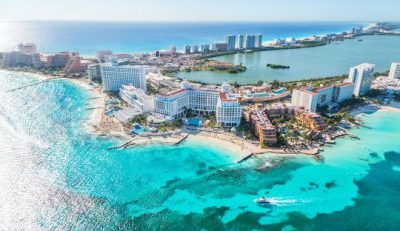
Our first day in Cancún didn’t go as planned. We got caught in a time-sharing scheme and ended up wasting almost half the day. But the evening made up for it—the Pirate Ship Tour was absolutely delightful and left us in a great mood.
The next morning, we had booked a tour to one of the modern wonders of the world: Chichén Itzá. So we woke up early, got ready, had breakfast in a beautiful restaurant in the hotel lobby, and waited for our tour bus.
From our hotel, a small van took us to another resort, where we boarded a large tour bus. We drove west for nearly three hours. On the way, the landscape was filled with dense shrubs that grew up to ten feet high—almost no tall trees in sight. The villages along the road reminded me so much of rural India. The only difference was the lack of crowds.
Around 11 AM, we reached Chichén Itzá.
This magnificent structure belonged to the Maya civilization, and nothing about it felt small or ordinary.
We had to walk nearly a quarter mile from the bus parking area to the entrance. From the ticket counter all the way to the pyramid, both sides of the path were lined with stalls selling clothes, beads, stones, and handmade crafts—once again reminding me of India.
As we crossed the last row of shops and looked up at the pyramid, we literally fell silent.
There it stood—majestic, mighty, stretching upward like a mountain challenging the sky. For centuries, it had remained there, timeless and powerful, as though it had been waiting for us. It was the first truly ancient structure we had seen on the American continent.
The stone blocks had weathered and crumbled in many places, so the entire pyramid was cordoned off with ropes. No one was allowed to climb. For those who dreamed of going up, it was disappointing, but necessary to preserve the monument.
While the guide spoke, I didn’t listen much. I simply stood there, unable to blink, staring at the structure.
There were other impressive buildings around the main pyramid—each tall and striking. The heat was intense that day; the sun felt sharp and scorching.
Just then, Siri started complaining that she didn’t want to walk anymore.
Since ours was a guided tour, Satya, Varu and the rest followed the group ahead, and I sat with Siri under the first shady tree on a bench. Even from there, Chichén Itzá stood towering before me, whispering its ancient stories.
It wasn’t surprising that this grand monument made it to the list of the New Seven Wonders of the World.
The local people there were mostly of Mayan descent. Watching them, talking to them filled me with joy. They were short and stout, distinctly characteristic of the Maya people. It was incredible to think that their ancestors had built something so gigantic and awe-inspiring.
Records suggest the construction took place between AD 750 and 900.
Chichén Itzá was once the major city of the Yucatán Peninsula in Mexico. The entire region is filled with natural underground water channels called cenotes. These are massive freshwater reservoirs, and in many places, they form deep wells. Some water channels even flow through underground caves.
In the local language, “Chichén Itzá” means “the entrance to the water cavern belonging to the Itzá people.”
The towering main pyramid is called El Castillo (“The Castle”) in Spanish. Locals refer to it as the Temple of Kukulkán, built in the shape of a stepped pyramid.
Chichén Itzá is not just one structure it spreads across nearly five square kilometers, a complex of many ancient buildings.
Archaeologists divide the site into four major zones:
- Castillo Pyramid
- Las Monjas (The Nunnery)
- Osario Group
- The Southern Complex
All these structures were built using a type of limestone found locally. In ancient times, they were painted in vibrant red, green, blue, and purple using dyes sourced from trees and stones.
Some of the main attractions at the site include:
- El Castillo (Temple of Kukulkán)
- Temple of the Warriors and the Great Ball Court
- Temple of Xtoloc in the Osario group
- The Caracol (observatory)
- Las Monjas
- Akab Dzib
- And to the south, Chichén Viejo (Old Chichén)
Each structure carries its own history, purpose, and architectural mystery.
*****
(to be continued)


A post graduate in English literature and language and in Economics. A few of my translations were published. I translated the poems of Dr. Andesri , Denchanala, Ayila Saida Chary and Urmila from Telugu to English. I write articles and reviews to magazines and news papers. To the field of poetry I am rather a new face.