
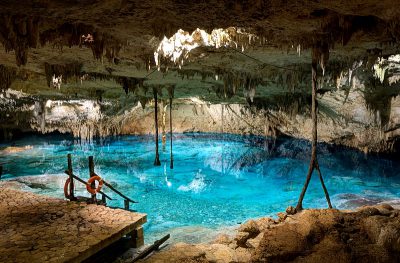
Yatra Geetham
Cancun – Tulum – Coba – Cenote – Maya Village – 2
Telugu Original : Dr K.Geeta
English Translation: V.Vijaya Kumar
The next morning, we booked a tour to visit Tulum, Coba, Cenote, and Maya Village. Since a swim in the cenote is a mandatory highlight of this full-day tour, we packed our bags with swimwear and essentials. We didn’t have to worry about lunch, as a traditional meal at a Maya Village was included in the itinerary. As for hydration, water bottles were available in the van whenever we needed them.
Unlike our previous trip, this wasn’t a large bus tour. It was a compact van that seated ten people, where our driver doubled as our guide. Along with us, four others joined from different resorts—a pair of young women and an elderly couple, all Americans. With the four of us (including our two children) and the driver, we were a group of nine traveling together for the day.
Since we occupied the front seats, I took the opportunity to chat with our driver-cum-guide about the local lifestyle and economic conditions. When I asked about drug trafficking and safety concerns in Cancun, he remarked, “In America, no matter how much insecurity exists, they don’t let it surface. Here, even the smallest incidents are shown through a magnifying glass.” It felt like there might be some truth to his perspective. He explained that since Cancun is a major tourist hub, the primary livelihood for the youth is completing hotel management courses, gaining proficiency in English, and securing jobs at resorts. He had worked in that industry for several years himself before becoming a driver for this tour company. Despite his youthful appearance, he was a father of two and a descendant of the Maya people, born and raised in the region.
I must say, this journey was the best of all. If one truly wants to see the descendants of the Maya, their villages, and their culture, this tour is an absolute must.
The Walled City by the Sea: Tulum
Tulum is located about 90 miles from Cancun, a journey of roughly two hours. It belongs to the state of Quintana Roo in Mexico’s Yucatan Peninsula. Tulum is a pre-Columbian Maya walled city perched on the cliffs along the ocean. This city flourished grandly before the arrival of Spanish conquerors in the 15th century but was later abandoned by the 18th century, primarily due to the rapid spread of diseases brought by the settlers.
Similar to Chichen Itza, the structures here are built from a specific type of limestone. Within the city of Tulum, alongside modest dwellings, there are three main structures:
El Castillo (The Castle)
The Temple of the Frescoes
The Temple of the Descending God
However, as part of conservation efforts, every structure is cordoned off with ropes. We couldn’t go inside, so we explored the site by walking around the exterior.
Though Tulum sits on a small cliff overlooking the sea, the coastline below is characterized by shifting sand dunes. In its prime, it served as a major seaport and a bustling center for trade and commerce. It is said that from two main windows on the seaward side of El Castillo distant ships could be spotted. The light from lamps lit here acted as a beacon, helping ships navigate the coast at night.
The Yucatan Peninsula generally lacks tall trees, and here, there was nothing but low-lying coastal scrub. The primary source of survival for a city in this coastal location was the freshwater from the nearby underground Cenotes.
Since our driver was also our guide, he explained the historical significance of everything. When my daughter, Siri, started throwing a tantrum, refusing to walk while we explored the ruins, he kindly gave her his tablet to play with and kept her company. This allowed me to walk around and soak in the sights peacefully.
As I wandered through the ruins, gazing at the stone structures, the lifestyle of the ancient people began to unfold before my eyes. Looking down from the highest point, I saw the beautiful pale blue sea and the surrounding white sands. I couldn’t help but imagine how enchanting this place would look on a moonlit night. Surrounded by the melodic rhythm of the waves, it became clear that the Maya people were true connoisseurs of beauty to have built a city in such a breathtaking location.
After nearly an hour and a half, we left the place quite reluctantly. However, an hour later, when we reached the ruins of “Coba,” I was absolutely stunned. The main structure was incredibly tall—I don’t recall seeing such a magnificent, towering edifice anywhere in recent memory.
*****
(to be continued)


A post graduate in English literature and language and in Economics. A few of my translations were published. I translated the poems of Dr. Andesri , Denchanala, Ayila Saida Chary and Urmila from Telugu to English. I write articles and reviews to magazines and news papers. To the field of poetry I am rather a new face.