

‘Cricket, camera and the female form’
-Ramadevi Singaraju
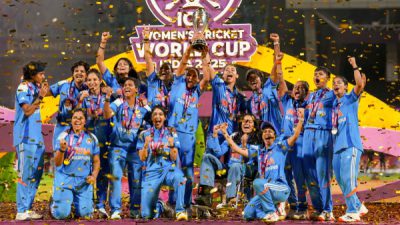
Most of you must have watched the thrilling final match of ICC women’s cricket World Cup, a couple of months back. While I was thrilled and rejoiced at the historic win of our women in blue, watching the women cricketers on TV that night also brought a thousand other thoughts into my mind. I felt that the win was not only a celebration of the grit and sporting abilities of these amazing sports women but also a novel lesson in viewing of the female form in general on screen. The match provided a new dynamic, a new gaze, a whole new perspective on the images of women, something very different from the image we all are so used to and very well trained to view on screen.
 |
In the popular culture of films and TV shows in the liberalized and globalized era of the 1990s, the camera presented the female body as an object of desire, a consumer product designed for maximum customer satisfaction. When we think we are watching something on screen, we can in reality, only watch what the camera wants us to watch or to put it the other way, only the image it focuses on. So ‘it’ trained us, the viewers to focus on the vital statistics of a woman’s body, it’s curves and contours etc,etc., whenever a woman appears on screen. |
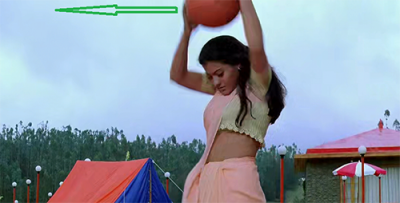
| Let me elaborate with a few examples. So when you watch kajol running towards the moving train to meet Shahrukh Khan in the important climax scene of the Hindi film ‘Dilwale dulhania le jayenge’( DDLJ), the camera focuses not on kajol’s running legs but on her heaving bust. In another iconic hit from 90’s ‘kuch Kuch hota Hai’, Kajol plays basket ball, wearing a chiffon saree with loose hair, lipstick and make up. Again here, when Kajol jumps up into the air in an effort to put the ball into the basket, the camera focuses not on the basket or ball or even the arms throwing the ball. Instead it focuses on kajol’s pallu, exposed midriff and the navel. | 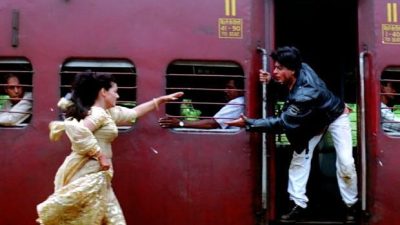 |
Similarly in various other films the camera trains you to focus on the ‘dhak dhak’ going bust of Madhuri Dixit or the gyrating hips of Sridevi in chiffon sarees and designer skirts or Karishma Kapoor’s crass dance movements on a khatiya. Coming to the 2000s, you have bolder and explicit versions of the Bollywood heroine in Bipasha Basu, Mallika Sherawat, Kareena Kapoor, Deepika Padukone and Priyanka Chopra all playing to the growing demands of the commercial market. So the camera once again places them at the center of the screen with a group of drooling half naked men surrounding them and ogling at their smooth and slick sculpted bodies.
The liberalised market did not spare the men either. The market potential of a ‘modern liberated female viewer’ and the expanding ‘gay market’ pushes even the male heroes to shed their clothes. Salman Khan, I believe is the ‘pioneer’ in shedding the shirt. So you have the camera once again focusing on the six pack body of Shahrukh Khan, Salman Khan or Aamir Khan in these Bollywood movies. There were other new age male sex symbols like Akshay Kumar, John Abraham and Milind Soman doing the same.
Meanwhile the South Indian films continued their obsession with heroine’s body in rain-drenched sarees and exposed midriff.
To sum up, the viewers were trained to focus on certain aspects of a female body when it appears on screen . While the films thus focused on the body as a commercial object, the daily TV serials took upon themselves the burden of upholding the ” culture” and ‘family values’ . So you had the stereotypical Saans- Bahu serials where the camera here focuses on the cunning and plotting face of the’ saans’( Mother- in- law) and the suffering weeping face of the’Bahu’(Daughter-in-law) . The love stories on the other hand showed young women as physically and emotionally weak beings in constant need of a male support and patronage.
The foreign channels like MTV and channel of course presented a more bolder and modern female with even less clothing. So these films and TV shows showed two extreme images of the female gender, one bold and sexy, the other docile and weak both very different from the real life educated, earning, independent, modern and confident women who are comfortable with their sexuality but don’t feel the need to expose and thus seek the validation of male gaze or the market demands.
The commercial advertisements again use the female body to sell a wide range of products from cosmetics to cars from washing powders to wines. Alternating between traditional saree clad models to models in glamorous attire depending on the kind of product they are selling, they manipulate the consumer’s emotions to promote their products. Here too the camera once again focuses on the body as a product. So whether it is a film or a serial or an ad you are watching on screen none of them presented the real image of a woman but all of them focused on her body as an object to satisfy the male gaze and feed into their sexual fantasies or as a vehicle to promote consumer products.
Coming back to the ICC women’s cricket world cup final which took place on second November 2025, when billions of people in India and across the world watched the women in action on their TV screens, they were watching a totally different scenario from the one that they were trained to watch in films,TV shows or Ads.
The camera for once focused on the ball and the bat. The women are dressed not to please your eyes but for the game. They do not have zero size bodies but bodies trained to endure the physical demands of an exerting game. They display neither coyness nor seductiveness but pure physical stamina and mental strength. They run, jump, chase, lunge and throw themselves at the ball. They huddle together as a team, devising game plans, appreciating each other, shouting words of advice, praise and caution, cheering for each other… all actions part of the real hard game they were playing; not the camera orchestrated ,slow motion movements meant to seduce and titillate the viewer.
By winning the long awaited and long-dreamt World Cup trophy in women’s cricket these women not only won the hearts of millions of Indian fans but also broke a thousand gender stereotypes prevalent in our society and public imagination.
We all know that this moment is a coming together of years of hard work, determination, sweat and tears of hundreds and thousands of women players, their families, coaches not only in cricket but in all other sports of our country. We already have quite a few women role models in sports like Mithali Raj,,Jhulan Goswami ,Sania Mirza ,Saina Nehwal ,PV sindhu , Mary Kom ,Karana Malleeswari and Koneru hampy to name a few popular and prominent names coming to my mind at the moment.
So you might argue that women’s cricket has been gaining prominence for quite some time now, and it is not the first time there’s a live telecast of women’s cricket on TV or for that matter, telecast of any women’s sport. Yes true, but the craze and reach of cricket as a game in India is huge and vast compared to other games and winning a world cup in cricket is certainly the first and a huge one at that! This is a watershed moment simply because of the sheer impact it can make on young minds in cultivating an image of the female gender very much different from the images of women popular culture tries to create and propagate.
On that night, with fire in their eyes, swing in their arms, steel in their nerves and a spirited gait, those cricketers strode the world sporting stage with amazing confidence calm exterior and fiery ambition in their bellies. These were all strong women with a sense of purpose, ambition and great mental toughness. They meant serious business!
So as viewers we were subjected to a totally different image of the female body. We were given a lesson on the true talent and capabilities of women sports persons and in the process, the myths propagated by the mainstream commercial cinema and TV serials in the name of culture or commerce that project women as beautiful but dumb sexual objects who are physically weak and mentally unstable stand thoroughly demolished!
This was one big powerful message the players sent out that night! That was the image of a female they created in the minds of millions of people watching the game and that is the image that will remain in the minds of people for a long time.
It is very different from the traditional homemaker role that society dictates or the bold and beautiful model that market demands but it is the image of a ‘physically fit, mentally strong and self confident woman with a mind of her own’ that will be shared, cherished and followed by millions of growing girls and boys of the coming generations.
One more important thing! Watching thousands of men and young boys in the stands, cheering for the players that night was not only a heartwarming sight but also a new trend setter in the public viewing of the sport and viewing of women as a society. For these cheering fans, the game mattered, not the gender of the players!
These male fans too sent out a quiet message of the model of a man, who is not insecure, irritated, threatened or intimidated by a woman’s success but who cheers for her, celebrates her success and also who in the process celebrates the spirit of sport, human determination and resilience!
So that is the biggest takeaway for me on that wonderful night.
*****


పేరు : సింగరాజు రమాదేవి ఊరు : వరంగల్, తెలంగాణా వృత్తి : ఎల్.ఐ.సి ఆఫ్ ఇండియా లో సాహిత్యం, సినిమాలు ఇష్టం. పాత తెలుగు హిందీ సినిమా పాటలు ప్రాణం. 1999 నుండి అనేక ప్రముఖ దిన,వార,మాస పత్రికలలో,అంతర్జాలంలో కథలు, కవితలు, వ్యాసాలు, అనువాద కథల ప్రచురణ.పలు కథలు, కవితలకు పోటీలలో బహుమతులు.పలు నాటకాలు, గేయాల రచన. *ఆగస్ట్ 2014 లొ కధా సంపుటి ’ఒక పరిచయం… ఒక పరిమళం’ విడుదల.