Poems of Aduri Satyavathi Devi
Poem-11
Childhood Shared witha Babe
Telugu Original: Aduri Satyavathi Devi
English Translation: Munipalle Raju
To have a glimpse of the new-born
On our invitation
You all come flying and land here
like beaming butterflies –
Moving freely with teeny weeny guests
We embellish the evening superlatively.
And elaborate the string of fortunes and promotions
Brought forth by our babe
Akin to an adolescent chunk of lunar sheen
And go on illustrating to our best.
Her coy smiles and clever looks-
The dusk gets trapped in between,
Even before the star lamps spread around the sky,
The luminous chandeliers moving in and out
Lit up the space around,
And our suckling passes into a series of hands
Like a frolicking moon in the crib of floating nimbus-
You all drown the infant with fragrant blessings
Like the grove showering Parijaatas ,
While a nose gay perfume loiters around
Regretting the delay
Saucers full of savouries, cups of ice cream,
Chocolates and tea, greet you all in a rush,
The sweating new moon
Till then held on a tight leash of choking discipline
Flutter about like pigeons
And scatter around the premises
Transforming into a beau of vibrating iridescence,
The Gulmohar leaning onto the Compound wall
With the help of breeze leaves more than a trace
Of her scented titillation
We, deep in our conversation that began with
Golden girls and encomiums to Telugu Motherhood
Journey into the latest world affairs-
The spectacle of childhood melee
Unfolding in front creeps into our spine
A precious adolescence like a quick footed squirrel
Nibbles at the ripe guava of reminiscences,
Mellowed, gliding past the slippery steps,
Running behind the traces
We halt at the scene
Of bud sheltering in the lap of a branch
And rocking back and forth again and again
And become laden, juicy selves, like bunch of grapes.
While the parrot-bitten childhood
Gleams like a beauty spot on the face of life,
The conscience, a lactic flow of Godavari
Seeps into the roots of this existence-
Now and then, how good it will be
To have a few similar dusks of elan
Lively and throbbing
*****
Telugu Original : ‘Paapayitho Panchukunna Baalyam’
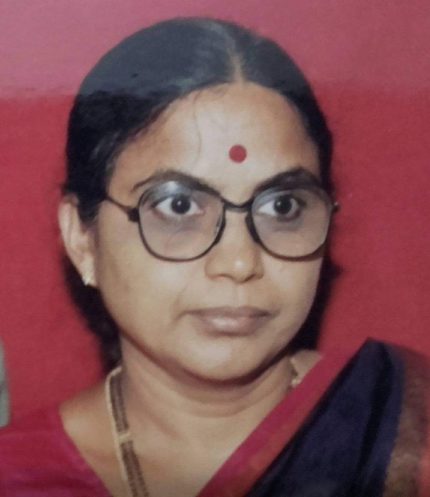
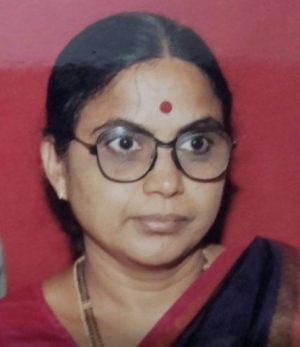
Aduri Satyavathi Devi was born in Guntur in the year 1948 and settled in Visakhapatnam after marriage in 1969. She began her literary career as a lyricist at the age of 13. She wrote a variety of lyrics numbering about 300 — light, classical, devotional, patriotic, children’s and others. More than 50 songs of Satyavati Devi were broadcast over All India Radio. Eventually she made forays into various other literary genres like Poetry, Short story, Essay, Radio Play, Musical Feature, Books, Film reviews, Forewords etc..She created a substantial corpus of poetry with more than 180 poems included in 4 anthologies of poetry. She received accolades from readers, scholars, critics and litterateurs for her sensitive rendering of poems. She participated in many Poetry Meets, Festivals conducted by All India Radio, Doordarshan and the Sahitya Akademi. She was widely translated into English and Hindi. Some of the translations appeared in renowned journals like Indian Literature (English), and Samakaaleen Bharateeya Saahitya (Hindi).
She published her first volume of lyrics Vennello Venugaanam in 1988. Her first volume of poetry Rekkamudavani Raagam was published in 1992 followed by Jalapaata Geetam in 1997 and Veyirangula Velugu Raagam in 2006. Hindi translation of Rekkamudavani Raagam came out in 2008 as “Pankh an Modnevaalaa Raag” and a miscellany of various facets of her literary endeavour Vennela Paarijaataalu was published posthumously in Dec 2008. She received many prizes and awards for her literary pursuits and accomplishments like STVD Kalasamithi Award for Rekkamudavani Raagam in 1993, and Telugu University’s “Pratibha Puraskaram” as “Best Poet” in 1994, “Krishna Sastry Award” from Andhra Lalita Kala Samithi (Secunderabad) in 1998, UNESCO Literary Award in 2000, and “Ramavruksha Benipuri Janma Sataabdi Sammaan” from Jaimuni Academy (Panipat) in 2002. An English translation of her poem, “Veyirekkala Pavuram” (Myriad Winged Bird) has been included in the syllabus of English texts in the poetry section of Degree year students by the Common Core syllabus Committee in AP from 2008.