
YATRA GEETHAM (Mexico) – 11
Cancun – Tulum – Coba – Cenote – Maya Village -5
Telugu Original : Dr K.Geeta
English Translation: V.Vijaya Kumar
Our return journey was just two days away. Up until then, we hadn’t taken a proper city tour of Cancun. Not only that, we had only traveled by taxis and tour buses, never experiencing how the local public transport worked. However, navigating the buses with kids seemed impractical, so we decided to leave both children back in the room and venture out just the two of us.
Our plan was set: first, head to the Jetpack ride that Satya really wanted to try, and then explore Market 28, a downtown Cancun market famous for local goods.
Waking up peacefully without the usual morning rush, we stepped out of the hotel around ten o’clock and hopped onto the very first bus that came down the road. The resort counter staff had guided us perfectly: every bus heading left from our hotel zone goes to the La Isla complex (where they sell Jetpack ride tickets), and every bus heading right goes to Market 28. Since local currency—”Pesos”—is essential for bus fares, we had already exchanged a hundred dollars at the resort ATM for two thousand pesos.
As soon as we boarded, seeing the blue and yellow seats inside gave me a sudden, familiar rush of joy, reminding me of buses back home. The buses weren’t crowded at all; there was no standing or rushing. Because a bus comes by every five minutes, finding a seat was incredibly easy. In fact, it turned out to be the perfect opportunity to observe the local people. To top it off, a one-way ticket from our hotel zone to downtown cost just eight and a half pesos per person—literally a tenth of what a taxi would cost!
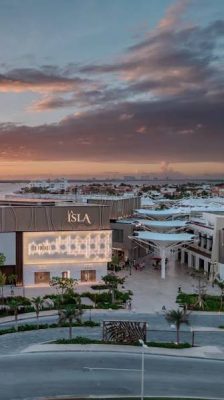
First, we headed to the La Isla complex for Satya’s anticipated Jetpack ride, which was just a ten-minute ride from our hotel. It was a massive, newly built mall. Perhaps because it was morning, it was completely empty. Unfortunately, tickets for the Jetpack ride were sold out for the day, so we had to turn back.
From there, we caught a bus straight to Market 28. Most of the tourists traveling with us got off at the main downtown stops near large shopping malls, movie theaters, museums, and game centers, leaving the bus almost entirely empty.
After about a half-hour ride, we got down at Plaza 28, the very first shop of Market 28. It is this plaza that gives the market its name. The square-shaped market stretches out for about a mile from this point; our plan was to explore the shops on foot and loop back here to catch the return bus.
This market is worlds apart from the luxury hotel zone of Cancun. This is where the authentic, local life truly thrives.
Plaza 28 is a shopping complex painted in vibrant pink walls. Right from the very first shop, vendors selling “Tequila”—the local alcohol—started calling out to Satya, inviting him inside. Seeing this, he quickly shifted from the side he was walking on to walk right next to me. I couldn’t help but laugh at his reaction.
All along the way, small shops lined the path selling everything from traditional clothing reflecting Mayan culture, beads, and stone jewelry, to brightly colored ceramic skulls. For me, being among people who felt so familiar brought an incomparable sense of happiness.
Along the road, shopkeepers kept urging us to buy local items to support their cottage industries. Curiously, the exact same items were priced higher in the smaller shops and cheaper in the larger ones. As is typical in such places, there were also variations in the quality of identical-looking goods.
Whenever I travel, I have a habit of buying small trinkets that fit in the palm of my hand for our glass display case at home. Keeping up with the tradition, I bought a few small, locally made wooden spring toys.
We also noticed t-shirts printed with profanities directed at Trump being sold along the way. A couple of vendors, upon realizing we had come from America, openly cursed President Trump. It brought back what our tour guide had told us the previous day—that this resentment stems from the harsh stance taken against undocumented Mexicans living in the US and the proposal to build a wall to curb illegal immigration between the countries.
Since we had already purchased items like keychains, local sweaters, hats, and clay dolls on our previous tours, we didn’t stop at those shops and kept walking forward.
After walking nearly a mile, we reached the end of the market and went into a nice, glass-fronted sweet shop. We bought half a dozen packs of sweets at ten dollars a pack. Some looked like our traditional pala kova pedas, while others were made of tamarind. To be honest, they weren’t quite worth the money, but we bought them anyway to distribute at our offices.
On the way back, alongside bananas and oranges, we spotted local varieties like sapotas as large as a palm and Pitaya (cactus fruit). At a small cart among the fruit stalls, a vendor was selling fruits slightly larger than Kashi jujubes, tossed with salt, chili powder, and lemon juice. I tried one, loved it, and bought a small bag of eight fruits for ten pesos, munching on them as we walked. It was a fruit with a large seed inside and a taste that blended mango and peach. Available during our November visit, this seasonal fruit is called the Mexican Plum, known locally as Ciruela.
Even though the shops everywhere prefer taking dollars over pesos, we insisted on using our pesos just to spend them. Along the way, I bought three hand fans for a hundred pesos. After bargaining at about four different shops, I finally bought a blanket at one shop for six hundred pesos. It was a handwoven blanket featuring local imagery like Chichen Itza, beautifully woven with red, orange, and yellow threads that I absolutely loved.
By then, it was nearing twelve o’clock. To make it back to the resort in time for lunch, we returned to Plaza 28 where we had dropped off. After standing there for ten minutes, we realized it was a one-way street!
Using whatever broken Spanish I knew, I asked the local shopkeepers for directions and walked forward. We eventually ran to catch a bus on the other side of a large circle near a big mart. As we kept asking every bus that passed, one driver told us that buses going to our hotel zone don’t stop there and asked us to walk a bit further down. After walking a little more, we finally caught a bus within another half hour.
Satya had tried desperately on his cell phone to see if rides like Uber were available. It made us realize that before hopping onto buses in an unfamiliar place, one must check the routes carefully. Every bus going from the hotel zone passes through downtown, but once you pass downtown and come from Market 28, not every returning bus goes exclusively to the hotel zone.
It makes me laugh thinking about it now, but at the time, we were incredibly anxious because we had left the kids alone at the hotel. We had no idea which bus number went where. Ultimately, we made it back to the resort in a rush by one o’clock, only to find both kids had showered, changed, and were happily watching TV.
*****
(to be continued)
A post graduate in English literature and language and in Economics. A few of my translations were published. I translated the poems of Dr. Andesri , Denchanala, Ayila Saida Chary and Urmila from Telugu to English. I write articles and reviews to magazines and news papers. To the field of poetry I am rather a new face.